My UX Maturity Framework
A leadership artefact for diagnosing where UX is actually operating: not whether a company has designers, but whether research, decision-making, systems, and delivery habits make better product work repeatable.
A systems-thinking framework for evaluating and upgrading UX maturity across large organisations.
Today I've been developing a new framework for monitoring and managing UX design organisation maturity. It's a simple model based on a quad chart matrix: four segments.
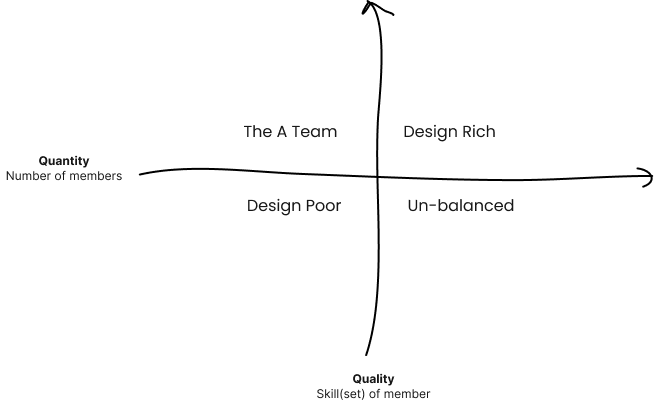
Along the horizontal axis we have a UX/design organisation maturity scale: this is composed of two factors — size and skillset: Number of members × skill set & level of members; which gives us a maturity rating.
And along the vertical axis we measure the experience map coverage and depth of the design team.
The complete quad is made of the results of two smaller quads which we could shorten to UX Scale by UX Scope.
Design Organisation Scale Quad Matrix
The Scale matrix offers us an opportunity to evaluate the maturity of our design organisation across a qualitative and quantitative metric: number of members by the skill level of the member.
Experience Map Quad Matrix
The UX Map quad matrix helps us to understand how much of the total user experience map is covered by design, and to what depth. We model the entire journey for all personas in our scope from A–Z, and multiply it by the depth of each step of experience. If we take the Storymapping model, this would be the Backbone Journey by Steps & Features (by the number of journeys).
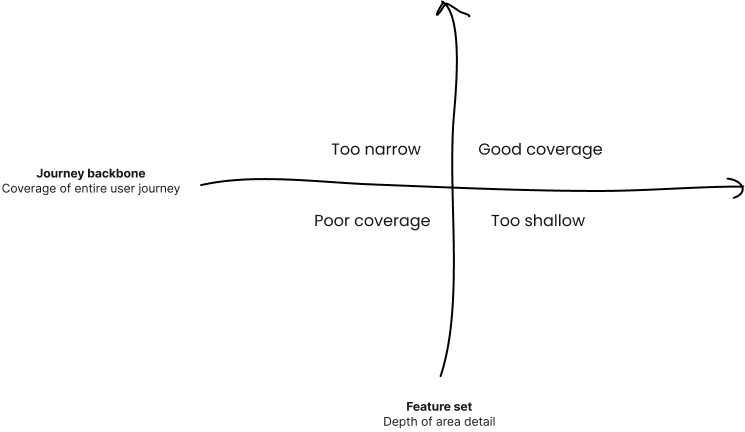
If the Journey is covered in its entirety, but the depth of the feature set per "step" is low, then the solution set is too shallow — and we may want to work on increasing the coverage for feature depth.
On the other hand, if the depth of the "step" is deep, but the entire user journey isn't sufficiently covered, then we are too narrowly focussed, and other areas of the experience will suffer.
UX Maturity Scale
The composition of two simplified metrics from the above user experience matrices combines to form a UX Maturity Map in the form also of a quad matrix.
This map will show us how we can tweak our design org to improve its overall maturity and fit for the enterprise:
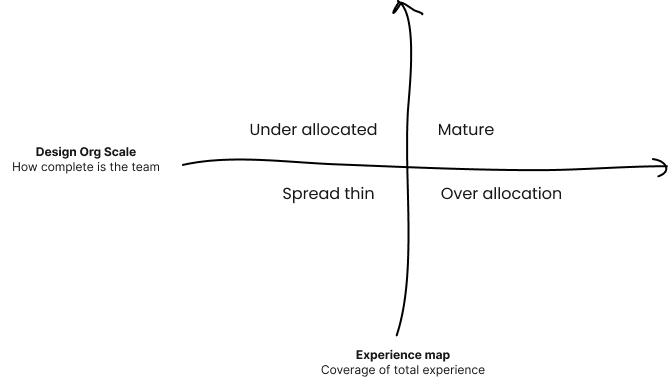
Quadrant A — "Spread Thin": The scale of the UX organisation is low, and the journey coverage is low. We have an overall poor design quality and coverage problem, and low UX team capacity.
Quadrant B — "Over allocation": The scale of the UX organisation is large compared with the scope of its journey map coverage requirement. We are over-allocated — we could consider moving some resourcing to more research, for example.
Quadrant C — "Under allocated": If the journey is covered but the team is immature, we are under-allocated.
Quadrant D — "Mature": When the design team maturity is high and the journey map coverage is high, this is the sweet spot for good design results.
If you would like to learn more about my UX organisation modelling, take a look at UX Architecture and reach out via the contact page.
- UX maturity is an operating-system question, not a talent-label question.
- A useful maturity model gives leaders a shared language for what needs to change next.
- The work should connect practice, tooling, research cadence, decision quality, and delivery behaviour.
- The point is not to score teams for theatre; it is to make the next organisational intervention visible.
This is one of the clearest bridges between the portfolio and Director-level conversations because it turns design leadership into something measurable, discussable, and actionable.