pip
A working but overgrown governance and information-architecture prototype for agentic development systems.
Pip was the ambitious messy middle of the current product-system story. It worked well enough to prove the idea: AI-assisted development needs mission, method, agent roles, workflow patterns, project graphs, activity logs, policies, and a publishing surface. It also became too broad, mixing governance, tooling, docs, scaffolding, blog infrastructure, and autonomous workflows before the architecture was fully understood.
Fast agentic delivery needs governance, but the first serious attempt can easily become a whole universe. Pip solved the right problem messily: how to give agents a project memory, role model, operating method, and decision structure before asking them to build.
- Define mission, method, and delivery process for an AI-assisted project.
- Give agents named responsibilities through a C-suite governance model: CEO, CTO, CPO, CISO, CMO, CRO, and COO.
- Capture formal agentic workflow patterns such as ReAct, planning, reflection, tool use, and multi-agent collaboration.
- Map product, marketing, and blog surfaces through project graphs and information architecture docs.
- Maintain activity logs, changelogs, policies, process checklists, and blog posts as a living project memory.
- Separate what should remain governance from what should become executable tooling, which later moved into Hatch and Bloom.
- The archive includes mission/method docs, agent governance, workflow patterns, graph files, policies, tooling docs, blog drafts, and activity history.
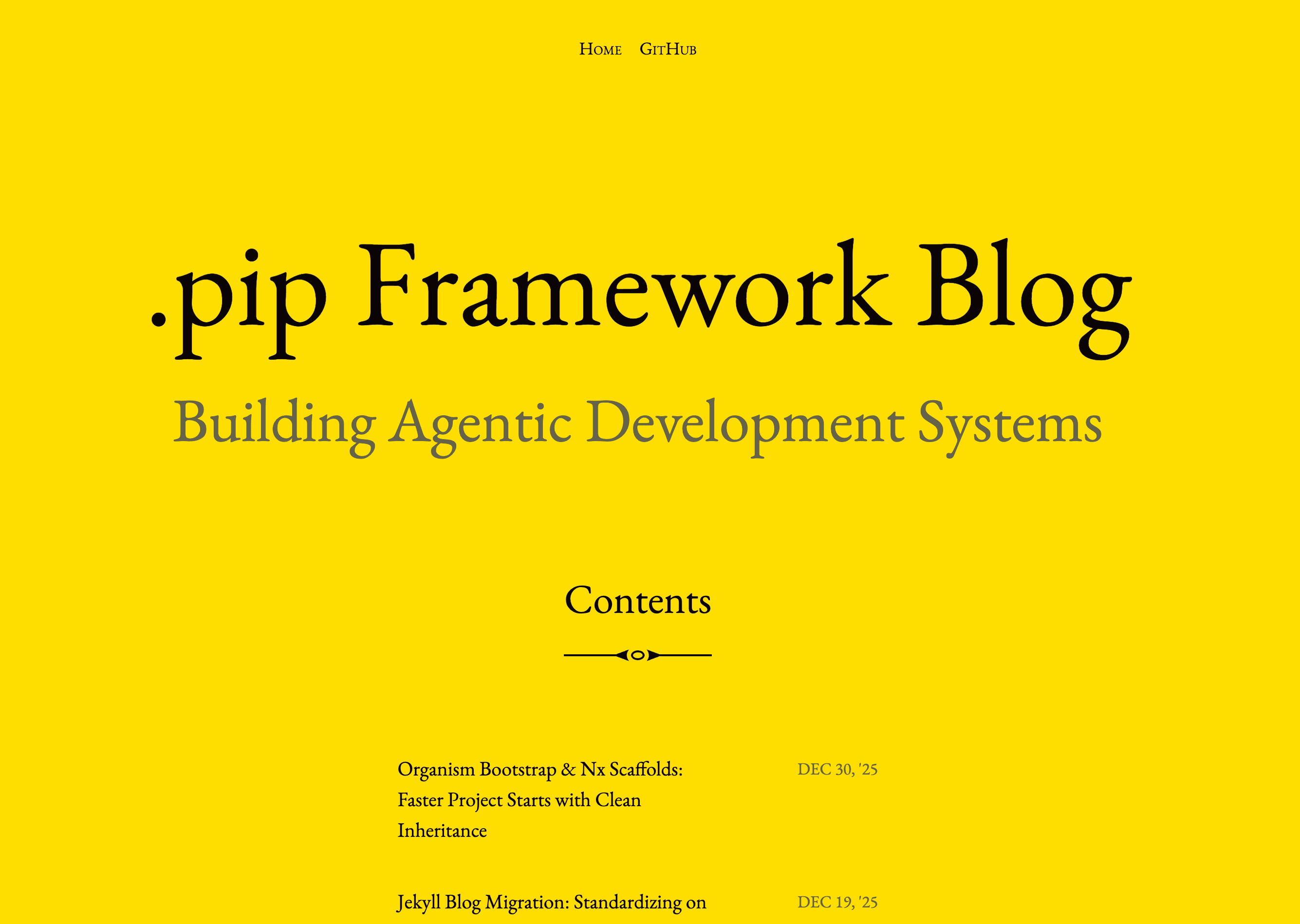
- The .pip Framework Blog was a real publishing surface for explaining agentic development systems.
- v3 extracted executable tooling into Hatch so Pip could become a pure information layer.
- The current soft tombstone maps Pip's durable ideas into Bloom rather than losing the learning.
- Shows governance as part of the product-building system, not an afterthought.
- Proves the narrative-angle rule in practice: Pip is interesting because it explains the evolution toward Bloom, not because it remained tidy.
- Captures the moment where a working prototype became too dense and needed to be decomposed into clearer products.
- Keeps the history of the model explainable instead of pretending the current architecture arrived fully formed.
Turn Pip into a richer evolution story: what worked, what became too messy, and which parts now live in Bloom, Hatch, Idea, Stack, Soul, and Shulkerbox.